

Centre Play (1973 to 1983) was a BBC anthology series of plays. It has briefly appeared here before, when I blogged about A Passage to Inverness, a complicated play about colonialism and family featuring a male stripper. I can’t tell you whether all the episodes are similarly ambitious, because as far as I knew at the time the only one on the internet was A Passage to Inverness, and I was pleased to see there are several others online now.
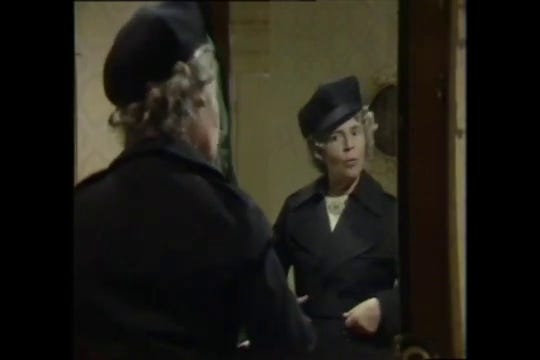
You Talk too Much is about Mrs Foster, a middle-aged lady who goes to her doctor complaining that she has logorrhoea, which is defined in the play as simply talking too much, or just not being able to stop yourself. The very good relationship she has with her GP is compared and contrasted with the relationship she has with her daughter and son-in-law, who is the one who has given her this diagnosis.
Interestingly I have had the same difficulty with You Talk Too much as I had with A Passage to Inverness, which is that it is really quite difficult to get to grips with. There are elements where the issue is the relationship withe the daughter and son in law, and there are occasions where the lady’s complaint seems to spill over into the field of mental health: the play could represent a personality trait being ‘psychiatrised’ by the family and/or doctor. There is also an element where Mrs Foster comes across as quite pushy and her daughter seems overly pushy so it’s not entirely clear whether the play is intended to be about the relationship.
It’s complicated by the fact that part way through the play she simply stops talking at all, which is contrasted with everyone else chattering away, including the doctor gossiping to his wife about his patients’ personal business, up to and including an abortion. The doctor admits he doesn’t know what to do about Mrs Foster.
Patricia Hayes, of course, plays Mrs Foster, to great effect. The role builds on the rather shrewish housekeeper role she played quite often, and she’s really quite creepy when she just stops talking.
My only criticism of this play is that Mrs Foster’s descent into approaching the GP to ask for help with her condition isn’t depicted as either violent or sudden enough. There could have been a single incident of disagreement with her family precipitating her visit or a depiction of real family ructions, but instead it comes across that the fanily has just been carrying on as it always did and yet she suddenly feels her lifelong behaviour needs help.
Ultimately this play is about relationships and communication, and the reality that everyone in this piece is busy chattering away and not listening to each other. Ironically Mrs Foster comes across as the most sensible one, and is also apparently the most talkative. She is depicted as the best-adapted character in that nobody else knows what to do and is constantly in despair, while she just gets on with it. We see her in one scene talking to herself in the mirror, which is depicted as a positive action to take. Talking is depicted as a bothersome, almost antisocial act, but yet not talking is a real problem.
You might say, and you’d be right, that this is a bit of a heavy drama and of course it is, but it has a very real sense of being a depiction of one sane person amongs utter incompetence and lunacy. A bit Alice in Wonderland, if you like.
And so we are at the end of Patricia Hayes’s TV appearances, at least the ones I am going to blog about. I was going to blog again about Grasshopper Island (1971) however on watching it again it’s struck me as quite different. I remember thinking it was an absolute delight when I first saw it, which from the boys’ point of view it probably would be. But on watching it again I’m not sure that depicting your three sons running round in their Y-fronts and going off with Charles Hawtrey who is described ambiguously as an ‘elderly boy’ and in the face of these things I have shied away from blogging about it again.
Conclusions
Before writing this series of posts I would probably have thought first of Patricia Hayes as Tony Hancock’s help, but have been struck by the sheer range of her roles. She shows a real versatility, to the extent that sometimes I have had to stop and check that the character I am looking at is actually Patricia Hayes, always the sign of an excellent actor in my book.
As always this series of posts has introduced me to things I didn’t know about before, primarily Edna the Inebriate Woman. I had never heard of it before, despite it apparently being Hayes’s best-known work. I have also now seen The Wall Came Tumbling Down, an episode of Hammer House of Mystery and Suspense which I had never seen but always been intrigued by its description.
This blog is mirrored at
culttvblog.tumblr.com/archive (from September 2023) and culttvblog.substack.com (from January 2023 and where you can subscribe by email)
Archives from 2013 to September 2023 may be found at culttvblog.blogspot.com and there is an incomplete index to the tags used on the Tumblr version at https://www.tumblr.com/culttvblog/729194158177370112/this-blog
There is an index to posts on the Substack version here: https://culttvblog.substack.com/p/index-of-posts?r=1q6qo6&utm_campaign=post&utm_medium=web&triedRedirect=true
About this blog: https://culttvblog.substack.com/about