

Content warning: self harm, ECT
As always, these series of posts about an individual actor bring things to my attention that I wouldn’t otherwise know about. This play is one of those and according to both Wikipedia and IMDB it is the work for which Patricia Hayes is best known, although I’d never heard of it until I started reading round for these posts. It was the second Play for Today and broadcast in 1971.
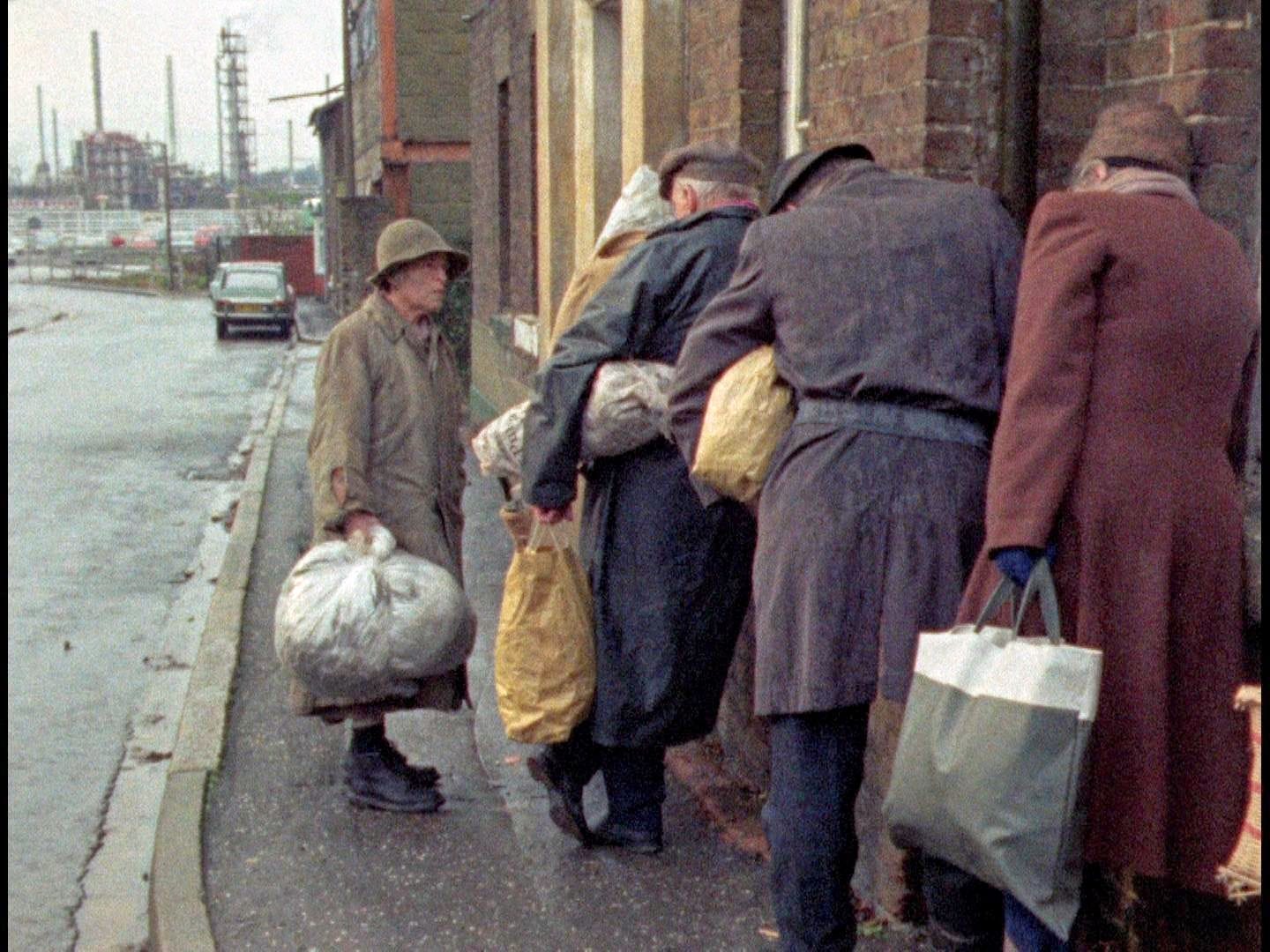
The play is about the titular Edna, who is what we would now call a homeless person, and it depicts her various adventures on the road, with hostels, hospitals, and even prison. Patricia Hayes plays Edna, inpossibly the most challenging role I have seen her in.
The main difficulty for the play is to depict Edna accurately without it becoming a depiction from Edna’s own point of view. The play was written by Jeremy Sandford, who as research, lived rough himself for two periods of weeks, and used much of the things people said to him directly in the play. I think this purely observational approach, with no explanatory material except as it is presented by the characters, explains a few interesting things about this play.
For a start I’m interested in the role of Edna’s alcoholism. Right at the start of the play she describes tremors which definitely sound like withdrawal. Yet considering this is given as the only major description of Edna in the title, it makes relatively little appearance in the rest of the play. It is rarely mentioned by the professionals she comes into contact with. She rarely talks about it. I’m not suggesting that this is a problem, I’m commenting on the depiction of Edna which avoids the only major description of her given in the title. I wonder whether this is intended to represent her own avoidance or denial of the problem, however I think generally the play is depicted as seen by an onlooker so we’re not allowed much insight into Edna’s own thought processes. Strangely, I think we only see Edna drinking an alcoholic drink once, and on the surface the viewer could miss that she’s an alcoholic at all.
There is an interesting theme of identity which recurs. In a time before logins and so on, Edna gives a different name to everyone she comes into contact with, and of course there was no way of checking her identity so everyone just fills in a new paper form with a different identity. Towards the end of the play we are startlingly given an insight into the disturbing conditions of Edna’s childhood which have left her as she is, which is again not overly explained or overtly applied to her present life, and we are left to apply these facts to her current identity and attachment. She has an interesting ‘thing’ that if ever she hears a telephone ring she immediately assumes it’s for her and demands to be given the receiver. Again we are given no explanation for this, but when a hospital porter, who is the only person who addresses this behaviour with her, points out that it’s for someone with a different name, Edna starts off saying her name but doesn’t finish. Identity is at the heart of Edna’s situation. Her tendency to go off on one whenever anyone calls her a vagrant (under the recently-repealed Vagrancy Act 1824), and loudly expostulating that she is not the vagrant, unfortunately isn’t explained. I expect it was a behaviour that Sandford saw on his research.
This identity theme extends at one point, to Edna pretending to be a man to get into a hostel, which surely nobody would have a problem with, so there are some gender issues here. There is another scene in a hostel where she is being offered some shoes and the man steers her away from the men’s clothes and expresses regret that women’s shoes aren’t as durable as men. I was cheering Edna on to tell him that she wanted some men’s shoes for her tramping and didn’t want women’s fripperies, but sadly she didn’t. Most startlingly, there is a scene where another homeless person describes being either hermaphrodite (suggested by having some surgery) or what we would now call transgender, although I’m not sure how much that word would have been available to audiences in the early 1970s. I am absolutely certain that for most viewers it would have been the first time most viewers had come across someone whose gender issues are described flatly without drama. The character is abundantly clear that she is not a ‘les’, and I’m sure that this, and every other scene, was a great shock to much of the viewers at the time.
The approach of depiction without much analysis means that I’m not sure what the viewer is intended to make of Edna and her situation. Probably you could have a good row at home over the TV set over it. No doubt there are monsters who would take the view that she was somehow morally at fault (remember that at this time in England and Wales you could still be sectioned under the Mental Health Act 1959 for alcoholism) and should have been punished or kept in a psychiatric hospital until ‘recovered’. There is an ongoing theme that the help she comes across really doesn’t help her in any meaningful way, except for one hostel owned by nuns and staffed by laypeople, which sets out to be the home its residents have never had, but unfortunately gets closed because it didn’t have planning permission. I am sure there are also people who would criticise Edna for ‘playing the system’.
Regular readers will not be surprised to know that I have an opinion about this which centres around the time she spends in a psychiatric hospital. They give her unnamed tablets, and she is seen having a single electro-convulsive therapy treatment, for no reason that I can see, makes a point of acting madder each time she sees a doctor so that she can stay in, and is ultimately discharged, being told by the doctor that she has no psychological needs. This is the summit of services letting her down, because given that they were giving her both tablets and ECT, they presumably felt she did have a treatable mental disorder. This is a difficulty with the way events are depicted in the play, that we can have no idea what the hospital staff were thinking, why they gave her treatment, or how she came across in any meaningful way. We just see the external events Edna experiences. This is not a criticism, it’s a feature of the approach taken, but it’s absolutely maddening! Unless the hospital gave her an alcohol detox and then didn’t bother to explore her inner life any further, I think they certainly could have concluded that she had a treatable mental disorder. For example another patient (played by our very own June Brown) dies after taking tablets Edna hasn’t been taking herself, and Edna really doesn’t seem bothered at all. At another point in the play she is depicted self harming, and of course there’s the alcoholism. There is a host of unaddressed mental health needs she’s got going on and I think of all the let downs she has in the play, the one by the psychiatric hospital is worst after the one by her mother.
You will read online that the ending of the play, where she tells her current traveling companion that she prefers to be alone and walks off on her own, suggests that she likes her way of life. I think that is only one of the things it could suggest and once again would suggest that the play is depicting behaviours and allowing the viewer to draw their own conclusion about them.
It is clearly a very challenging role and Hayes plays it incredibly convincingly. Both she and the play won awards.
I do have a few criticisms. The first is the obvious one that given that this play would have brought the reality of homelessness home (as it were) to many viewers for ths first time, itcan only have been expected to have a had a certain didactic function. Very much out of the same stable as the similar play Cathy, Come Home, also by Sandford. It is therefore, in my opinion, not really a play, despite the accuracy and sympathy of its depiction, there is a strong element of it being a fictionalised documentary. I do appreciate that making this as a documentary would have its own ethical issues, but I honestly think this is more documentary than play, assuming that a television play must at least have an element of entertainment.
My other criticism is a product of the play’s approach of depicting what is happening. Once again, as a former mental heath nurse of 25 years the sequence in the psychiatric hospital interests me most. The challenge for both the script and Patricia Hayes is to depict her acting mentally disordered in an attempt to get kept inside the hospital, while also actually being mentally disordered by virtue of her childhood experiences. At the same time she has to get kicked out because of pretending to be mentally disordered while having the staff miss that she is really quite mentally disordered.
Obviously we don’t know what the tablets they gave her were, but I can tell you for a fact that if you are an alcoholic in the alcohol-free surroundings of a psychiatric hospital, the staff will find this out very quickly. If you pretend to be mentally disordered they will also suss you very quickly. I think the problem here is that Sandford’s research didn’t include asking mental health professionals how to make it look convincing, and I do wonder whether the ECT scene was put in to indicate mistreatment by the hospital.
The whole sequence in the hospital raises questions and it would have been more convincing if she had been admitted for assessment, acted mad, been mistreated and beaten by the staff, and then absconded to break into the nearest shop for the whisky she was craving.
However I would not want these criticisms to make anyone think they shouldn’t watch this play which is an excellent depiction of observed life among homeless people in the early 1970s, and a stellar performance by Patricia Hayes.
This blog is mirrored at
culttvblog.tumblr.com/archive (from September 2023) and culttvblog.substack.com (from January 2023 and where you can subscribe by email)
Archives from 2013 to September 2023 may be found at culttvblog.blogspot.com and there is an incomplete index to the tags used on the Tumblr version at https://www.tumblr.com/culttvblog/729194158177370112/this-blog
There is an index to posts on the Substack version here: https://culttvblog.substack.com/p/index-of-posts?r=1q6qo6&utm_campaign=post&utm_medium=web&triedRedirect=true
About this blog: https://culttvblog.substack.com/about