
P.R.O.B.E.: The Zero Imperative

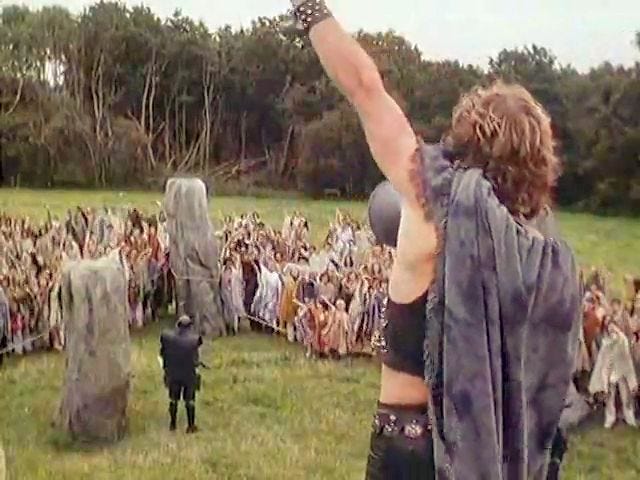
In my last post I wrote about the second and fourth episodes of the original four Mark Gatiss-scripted direct-to-video series P.R.O.B.E. And so now I come to the first. Yes, I know: you all come to this blog for the order, system and method which I apply to my subject. In fact in this post I'm even managing to illustrate the post with a still from a completely different TV programme, but the reason will become apparent.
In fact the reason I'm coming at this the wrong way round is that I have only laid my hands on this episode since writing my last post, so the disarray is caused by chance. I commented in that post that the two episodes were hugely ambitious with many themes and subjects touched on. Given its huge ambition I was delighted to see that the first episode doesn't trouble us with a lengthy explanation of what the Preternatural Research Bureau is about, and instead we're straight in to the business of the bureau. In this case a series of unexplained deaths in a ring surrounding a psychiatric clinic.
Of course given this series's status as the first Dr Who spin-off it is of note that it stars Sylvester McCoy, Peter Davison, Colin Baker, Jon Pertwee, Caroline John and Louise Jameson, you'll get that it feels a bit Five Doctors, or Three Doctors. I expect that was partly the aim, since P.R.O.B.E. and The Stranger are both intended to be Dr Who without the franchise. However unlike Dr Who The Zero Imperative also features topless model and actress Linda Lusardi in one of her few acting roles. She is an interesting introduction to the extended world of Dr Who and aren't I being good to leave my comments at that?
The two episodes about Winterbourne were obviously filmed on location in a real school, and The Zero Imperative makes excellent atmospheric use of what looks like a real NHS building, although I'm afraid I have failed to find out the location. We are shown an exterior or what looks like one of the smaller buildings used either for administration or the reception of new patients in the big old psychiatric hospitals. In a touch of irony, mention is made of the closing of the old hospitals under the Care in the Community initiative, when the episode was quite probably being filmed in a hospital closed for this very reason.
The Zero Imperative is a tighter story, with less 'stuff' incorporated. It feels less supernatural, nobody is sacrificed to the devil, and in terms of bizarreness it is placed much more at the X-Files level. It is an excellent introduction to the series and well-plotted, while still ending with a mystery. It also fits much more comfortably in a science fiction category, with for example, a hands free phone in a car well before I think such things existed, and while the subject of the investigation is essentially spiritual rather than science fiction, it feels much less far-reaching than the previous two episodes I blogged about.
For TV fans, interestingly the episode doesn't just connect naturally with Dr Who but also connects the Whovian world with that of Quatermass. I have read that in Remembrance of the Daleks (1988) the doctor refers to Bernard Quatermass as an old friend, although I have watched it several times in preparation for this blog post and haven't been able to find the reference myself. The specific connection between The Zero Imperative and Quatermass is that at the beginning we see a meeting of the Preternatural Research Bureau where the unexplained deaths are mapped around the clinic like spokes of a wheel and one of the deaths takes place at a place called Ringstone Round. This was the name of the stone circle which was one of the locations for the 1979 Quatermass series (given different names in different countries, apparently). In Quatermass Ringstone Round is very much coded for Stonehenge, and brings into play possibly the oldest British tradition of arguing at, about, or over Stonehenge, and its utility to ancient religions created last week. Also, in subsequent audio and novel adventures of Dr Who there exists a 1950s TV series called Nightshade, which is a disguised reference to the Quatermass franchise, with its name changed to avoid copyright problems. At one point in The Zero Imperative we see video tapes of Nightshade films. So the world of Dr Who references the world of Quatermass and the world of Quatermass enters the world of Dr Who and influences it.
I have tried very hard to find something negative to say about this episode, and despite watching it five times have had real difficulty doing so. The worst I've managed to come up with is a couple of criticisms of the credibility of the clinic and its treatment, which don't really feel very fair about a show which is obviously science fiction so needn't be based in the real world.
In general, though, this episode is a wonderful world through a fantasy world created from television, and joining several different worlds together and make something different of them. I love the ability of television to mix worlds together like this, give people worlds to escape to and friends they will never meet. In this way television does actually influence our world, and I've found a wonderful example of this from Quatermass.
In doing my random read around websites which happen to interest me in preparation for this blog post (which I am pleased to call Research) I was delighted to find that this nursery rhyme, written by Nigel Kneale for the 1979 Quatermass series, has since gained a life on its own and got out into the community. If you search its name you will find people arguing that it's a genuinely old nursery rhyme and they were taught it by their parents as children, although it's actually younger than I am. Isn't it wonderful how folklore works?
Credit: I am once again heavily indebted to the tardis.fandom site about both The Zero Imperative and Nightshade.
This blog is mirrored at
culttvblog.tumblr.com/archive (from September 2023) and culttvblog.substack.com (from January 2023 and where you can subscribe by email)
Archives from 2013 to September 2023 may be found at culttvblog.blogspot.com and there is an incomplete index to the tags used on the Tumblr version at https://www.tumblr.com/culttvblog/729194158177370112/this-blog
There is an index to posts on the Substack version here: https://culttvblog.substack.com/p/index-of-posts?r=1q6qo6&utm_campaign=post&utm_medium=web&triedRedirect=true
About this blog: https://culttvblog.substack.com/about